FIREARMS
The difference Types of Firearms
The term firearm is any type of gun designed to be readily carried and used by an individual(or group of people). The term is legally defined further in different countries (see Legal definitions).
The first firearms originated in 10th-century China, when bamboo tubes containing gunpowder and pellet projectiles were mounted on spears to make the portable fire lance,operable by a single person, which was later used effectively as a shock weapon in the Siege of De’an in 1132. In the 13th century, fire lance barrels were replaced with metal tubes and transformed into the metal-barreled hand cannon.
The technology gradually spread throughout Eurasia during the 14th century. Older firearms typically used black powder as a propellant, but modern firearms use smokeless powder or other propellants. Most modern firearms (with the notable exception of smoothbore shotguns) have rifled barrels to impart spin to the projectile for improved flight stability.
Modern firearms can be described by their caliber (i.e. bore diameter). For pistols and rifles this is given in millimeters or inches (e.g. 7.62mm or .308 in.), or in the case of shotguns by their gauge (e.g. 12 ga. and 20 ga.). They are also described by the type of action employed (e.g. muzzleloader, breechloader, lever, bolt, pump, revolver, semi-automatic, fully automatic, etc.), together with the usual means of deportment (i.e. hand-held or mechanical mounting).
Further classification may make reference to the type of barrel used (i.e. rifled) and to the barrel length (e.g. 24 inches), to the firing mechanism (e.g. matchlock, wheellock, flintlock, or percussion lock), to the design’s primary intended use (e.g. hunting rifle), or to the commonly accepted name for a particular variation (e.g. Gatling gun).
Types of Firearms
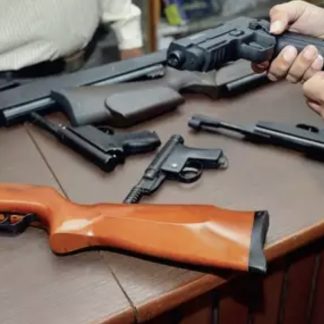
Handguns


Handguns are guns that can be used with a single hand and are the smallest of all firearms. However, the legal definition of a “handgun” varies between countries and regions. For example, in South African law, a “handgun” means a pistol or revolver which can be held and discharged with one hand. In Australia, the gun law considers a handgun as a firearm carry-able or concealable about the person; or capable of being raised and fired by one hand; or not exceeding 65 cm (26 in). In the United States, and the ATF considers a handgun as a firearm which has a short stock and is designed to be held and fired by the use of a single hand.
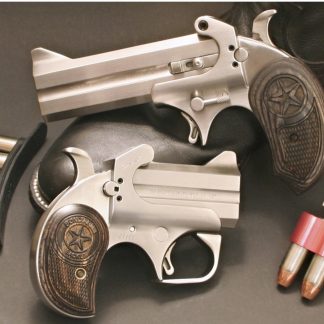
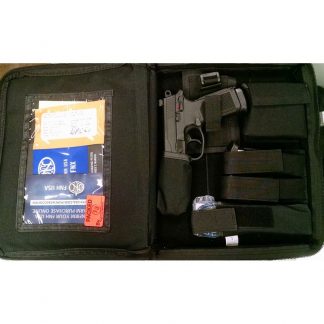
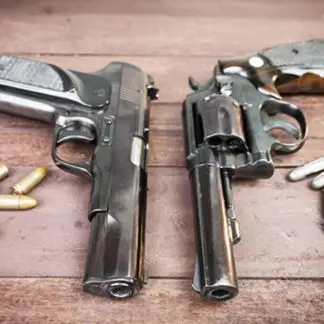
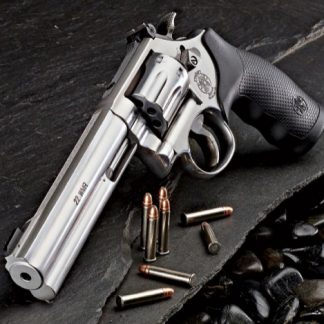
There are two common types of handguns: revolvers and semi-automatic pistols. Revolvers have a number of firing chambers or “charge holes” in a revolving cylinder; each chamber in the cylinder is loaded with a single cartridge or charge. Semi-automatic pistols have a single fixed firing chamber machined into the rear of the barrel, and a magazine so they can be used to fire more than one round.
Each press of the trigger fires a cartridge, using the energy of the cartridge to activate a mechanism so that the next cartridge may be fired immediately. This is opposed to “double-action” revolvers, which accomplish the same end using a mechanical action linked to the trigger pull.
With the invention of the revolver in 1818, handguns capable of holding multiple rounds became popular. Certain designs of auto-loading pistols appeared beginning in the 1870s and had largely supplanted revolvers in military applications by the end of World War I. By the end of the 20th century, most handguns carried regularly by military, police, and civilians were semi-automatic, although revolvers were still widely used.
Generally speaking, military and police forces use semi-automatic pistols due to their high magazine capacities and ability to rapidly reload by simply removing the empty magazine and inserting a loaded one. Revolvers are very common among handgun hunters because revolver cartridges are usually more powerful than similar caliber semi-automatic pistol cartridges (which are designed for self-defense) and the strength, simplicity, and durability of the revolver design is well-suited to outdoor use.
Revolvers, especially in .22 LR and 38 Special/357 Magnum, are also common concealed weapons in jurisdictions allowing this practice because their simple mechanics make them smaller than many autoloaders while remaining reliable. Both designs are common among civilian gun owners, depending on the owner’s intention (self-defense, hunting, target shooting, competitions, collecting, etc.).
Long guns
A long gun is any firearm with a notably long barrel, typically a length of 10 to 30 inches (250 to 760 mm) (there are restrictions on minimum barrel length in many jurisdictions; maximum barrel length is usually a matter of practicality). Unlike a handgun, long guns are designed to be held and fired with both hands, while braced against either the hip or the shoulder for better stability.
The receiver and trigger group is mounted into a stock made of wood, plastic, metal, or composite material, which has sections that form a foregrip, rear grip, and optionally (but typically) a shoulder mount called the butt. Early long arms, from the Renaissance up to the mid-19th century, were generally smoothbore firearms that fired one or more ball shot, called muskets or arquebus depending on caliber and firing mechanism.

Most modern long guns are either rifles or shotguns. Both are the successors of the musket, diverging from their parent weapon in distinct ways. A rifle is so named for the spiral grooves (riflings) machined into the inner (bore) surface of its barrel, which imparts a gyroscopically-stabilizing spin to the bullets that it fires. Shotguns are predominantly smoothbore firearms designed to fire a number of shot in each discharge; pellet sizes commonly ranging between 2 mm #9 birdshot and 8.4 mm #00 (double-aught) buckshot.
Shotguns are also capable of firing single solid projectiles called slugs, or specialty (often “less lethal”) rounds such as bean bags, tear gas or breaching rounds. Rifles produce a single point of impact with each firing but a long range and high accuracy; while shotguns produce a cluster of impact points with considerably less range and accuracy. However, the larger impact area of shotguns can compensate for reduced accuracy, since shot spreads during flight; consequently, in hunting, shotguns are generally used for fast-flying game birds.
Rifles and shotguns are commonly used for hunting and often also for home defense, security guard and law enforcement. Usually, large game are hunted with rifles (although shotguns can be used, particularly with slugs), while birds are hunted with shotguns. Shotguns are sometimes preferred for defending a home or business due to their wide impact area, multiple wound tracks (when using buckshot), shorter range, and reduced penetration of walls (when using lighter shot), which significantly reduces the likelihood of unintended harm, although the handgun is also common.
_(12753731154).jpg)
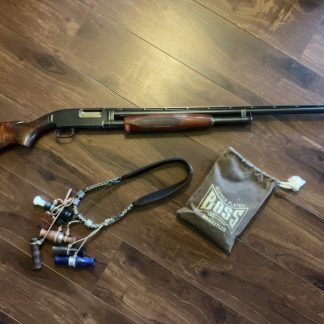
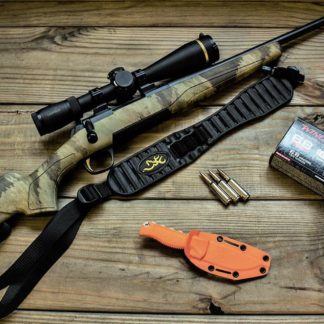
There are a variety of types of rifles and shotguns based on the method in which they are reloaded. Bolt-action and lever-action rifles are manually operated. Manipulation of the bolt or the lever causes the spent cartridge to be removed, the firing mechanism recocked, and a fresh cartridge inserted. These two types of action are almost exclusively used by rifles. Slide-action (commonly called ‘pump-action’) rifles and shotguns are manually cycled by shuttling the foregrip of the firearm back and forth. This type of action is typically used by shotguns, but several major manufacturers make rifles that use this action.
Both rifles and shotguns also come in break-action varieties that do not have any kind of reloading mechanism at all but must be hand-loaded after each shot. Both rifles and shotguns come in single- and double-barreled varieties; however, due to the expense and difficulty of manufacturing, double-barreled rifles are rare. Double-barreled rifles are typically intended for African big-game hunts where the animals are dangerous, ranges are short, and speed is of the essence. Very large and powerful calibers are normal for these firearms.
Rifles have been in nationally featured marksmanship events in Europe and the United States since at least the 18th century when rifles were first becoming widely available. One of the earliest purely “American” rifle-shooting competitions took place in 1775 when Daniel Morgan was recruiting sharpshooters in Virginia for the impending American Revolutionary War.
In some countries, rifle marksmanship is still a matter of national pride. Some specialized rifles in the larger calibers are claimed to have an accurate range of up to about 1 mile (1,600 m), although most have considerably less. In the second half of the 20th century, competitive shotgun sports became perhaps even more popular than riflery, largely due to the motion and immediate feedback in activities such as skeet, trap, and sporting clays.
In military use, bolt-action rifles with high-power scopes are common as sniper rifles, however by the Korean War the traditional bolt-action and semi-automatic rifles used by infantrymen had been supplemented by select-fire designs known as automatic rifles.
A carbine is a firearm similar to a rifle in form and intended usage, but generally shorter or smaller than the typical “full-size” hunting or battle rifle of a similar time period, and sometimes using a smaller or less-powerful cartridge. Carbines were and are typically used by members of the military in roles that are expected to engage in combat, but where a full-size rifle would be an impediment to the primary duties of that soldier (vehicle drivers, field commanders and support staff, airborne troops, engineers, etc.).
Carbines are also common in law enforcement and among civilian owners where similar size, space, and/or power concerns may exist. Carbines, like rifles, can be single-shot, repeating-action, semi-automatic, or select-fire/fully automatic, generally depending on the time period and intended market. Common historical examples include the Winchester Model 1892, Lee–Enfield “Jungle Carbine”, SKS, M1 carbine (no relation to the larger M1 Garand) and M4 carbine (a more compact variant of the current M16 rifle).
Modern U.S. civilian carbines include compact customizations of the AR-15, Ruger Mini-14, Beretta Cx4 Storm, Kel-Tec SUB-2000, bolt-action rifles generally falling under the specifications of a scout rifle, and aftermarket conversion kits for popular pistols including the M1911 and Glock models.
Machine gun

A machine gun is a fully automatic firearm, most often separated from other classes of automatic weapons by the use of belt-fed ammunition (though some designs employ drum, pan or hopper magazines), generally in a rifle-inspired caliber ranging between 5.56×45mm NATO (.223 Remington) for a light machine gun to as large as .50 BMG or even larger for crewed or aircraft weapons. Although not widely fielded until World War I, early machine guns were being used by militaries in the second half of the 19th century.
Notables in the U.S. arsenal during the 20th century included the M2 Browning .50 caliber heavy machine gun, M1919 Browning .30 caliber medium machine gun, and the M60 7.62×51mm NATO general-purpose machine gun which came into use around the Vietnam War. Machine guns of this type were originally defensive firearms crewed by at least two men, mainly because of the difficulties involved in moving and placing them, their ammunition, and their tripod. In contrast, modern light machine guns such as the FN Minimi are often wielded by a single infantryman.
They provide a large ammunition capacity and a high rate of fire and are typically used to give suppressing fire during infantry movement. The accuracy of machine guns varies based on a wide number of factors from design to manufacturing tolerances, most of which have been improved over time. Machine guns are often mounted on vehicles or helicopters and have been used since World War I as offensive firearms in fighter aircraft and tanks (e.g. for air combat or suppressing fire for ground troop support).
The definition of a machine gun is different in U.S. law. The National Firearms Act and Firearm Owners Protection Act define a “machine gun” in the United States code Title 26, Subtitle E, Chapter 53, Subchapter B, Part 1, § 5845 as: “… any firearm which shoots … automatically more than one shot, without manual reloading, by a single function of the trigger”. “Machine gun” is therefore largely synonymous with “automatic weapon” in the U.S. civilian parlance, covering all automatic firearms.

The definition of a sniper rifle is disputed among military, police, and civilian observers alike, however, most generally define a “sniper rifle” as a high-powered, semi-automatic/bolt action, precision rifle with an accurate range further than that of a standard rifle. These are often purpose-built for their applications. For example, a police sniper rifle may differ in specs from a military rifle. Police snipers generally do not engage targets at extreme range, but rather, a target at medium range.
They may also have multiple targets within the shorter range, and thus a semi-automatic model is preferred to a bolt action. They also may be more compact than mil-spec rifles as police marksmen may need more portability. On the other hand, a military rifle is more likely to use a higher-powered cartridge to defeat body armor or medium-light cover. They are more commonly (but not a lot more) bolt-action, as they are simpler to build and maintain.
Also, due to fewer moving and overall parts, they are much more reliable under adverse conditions. They may also have a more powerful scope to acquire targets further away. Overall, sniper units never became prominent until World War I, when the Germans displayed their usefulness on the battlefield. Since then, they have become irrevocably embedded in warfare.
Examples of sniper rifles include the Accuracy International AWM, Sako TRG-42 and the CheyTac M200. Examples of specialized sniper cartridges include the .338 Lapua Magnum, .300 Winchester Magnum, and .408 CheyTac rounds.

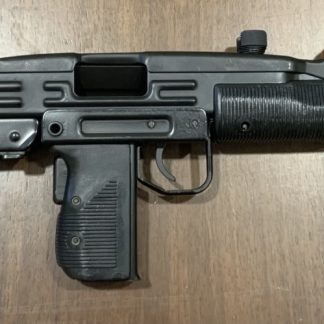
A submachine gun is a magazine-fed firearm, usually smaller than other automatic firearms, that fires pistol-caliber ammunition; for this reason certain submachine guns can also be referred to as machine pistols, especially when referring to handgun-sized designs such as the Škorpion vz. 61 and Glock 18. Well-known examples are the Israeli Uzi and Heckler & Koch MP5 which use the 9×19mm Parabellum cartridge, and the American Thompson submachine gun which fires .45 ACP. Because of their small size and limited projectile penetration compared to high-power rifle rounds, submachine guns are commonly favored by military, paramilitary and police forces for close-quarters engagements such as inside buildings, in urban areas, or in trench complexes.

Submachine guns were originally about the size of carbines. Because they fire pistol ammunition, they have limited long-range use, but in close combat can be used in fully automatic in a controllable manner due to the lighter recoil of the pistol ammunition. They are also extremely inexpensive and simple to build in times of war, enabling a nation to quickly arm its military.
In the latter half of the 20th century, submachine guns were being miniaturized to the point of being only slightly larger than some large handguns. The most widely used submachine gun at the end of the 20th century was the Heckler & Koch MP5. The MP5 is actually designated as a “machine pistol” by Heckler & Koch (MP5 stands for Maschinenpistole 5, or Machine Pistol 5), although some reserve this designation for even smaller submachine guns such as the MAC-10 and Glock 18, which are about the size and shape of pistols.
An automatic rifle is a magazine-fed firearm, wielded by a single infantryman, that is chambered for rifle cartridges and capable of automatic fire.
The M1918 Browning Automatic Rifle was the first U.S. infantry weapon of this type, and was generally used for suppressive or support fire in the role now usually filled by the light machine gun. Other early automatic rifles include the Fedorov Avtomat and the Huot Automatic Rifle. Later, German forces fielded the Sturmgewehr 44 during World War II, a light automatic rifle firing a reduced power “intermediate cartridge”. This design was to become the basis for the “assault rifle” subclass of automatic weapons, as contrasted with “battle rifles”, which generally fire a traditional “full-power” rifle cartridge.

In World War II, Germany introduced the StG 44, and brought to the forefront of firearm technology what eventually became the class of firearm most widely adopted by the military, the assault rifle. An assault rifle is usually slightly smaller than a battle rifle such as the American M14, but the chief differences defining an assault rifle are select-fire capability and the use of a rifle round of lesser power, known as an intermediate cartridge.
Soviet engineer Mikhail Kalashnikov quickly adapted the German concept, using a less-powerful 7.62×39mm cartridge derived from the standard 7.62×54mmR Russian battle rifle round, to produce the AK-47, which has become the world’s most widely used assault rifle. Soon after World War II, the Automatic Kalashnikov AK-47 assault rifle began to be fielded by the Soviet Union and its allies in the Eastern Bloc, as well as by nations such as China, North Korea, and North Vietnam.
In the United States, the assault rifle design was later in coming; the replacement for the M1 Garand of WWII was another John Garand design chambered for the new 7.62×51mm NATO cartridge; the select-fire M14, which was used by the U.S. military until the 1960s. The significant recoil of the M14, when fired in full-automatic mode, was seen as a problem as it reduced accuracy, and in the 1960s it was replaced by Eugene Stoner’s AR-15, which also marked a switch from the powerful .30 caliber cartridges used by the U.S. military up until early in the Vietnam War to the much less powerful but far lighter and light recoiling .223 caliber (5.56mm) intermediate cartridge.
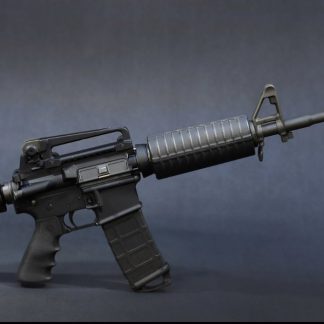
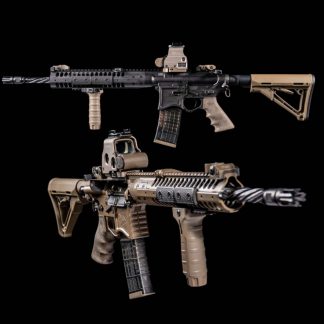
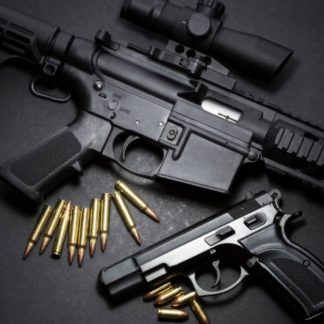
The military later designated the AR-15 as the “M16”. The civilian version of the M16 continues to be known as the AR-15 and looks exactly like the military version, although to conform to ATF regulations in the U.S., it lacks the mechanism that permits fully automatic fire.
Variants of both the M16 and AK-47 are still in wide international use today, though other automatic rifle designs have since been introduced. A smaller version of the M16A2, the M4 carbine, is widely used by U.S. and NATO tank and vehicle crews, airbornes, support staff, and in other scenarios where space is limited.
The IMI Galil, an Israeli-designed weapon based on the action of the AK-47 is in use by Israel, Italy, Burma, the Philippines, Peru, and Colombia. Swiss Arms of Switzerland produces the SIG SG 550 assault rifle used by France, Chile, and Spain among others, and Steyr Mannlicher produces the AUG, a bullpup rifle in use in Austria, Australia, New Zealand, Ireland, and Saudi Arabia among other nations.
Modern designs call for compact weapons retaining firepower. The bullpup design, by mounting the magazine behind the trigger, unifies the accuracy and firepower of the traditional assault rifle with the compact size of the submachine gun (though submachine guns are still used); examples are the French FAMAS and the British SA80.

A recently developed class of firearm is the personal defense weapon or PDW, which is in simplest terms a submachine gun designed to fire ammunitions with ballistic performance similar to rifle cartridges. While a submachine gun is desirable for its compact size and ammunition capacity, its pistol cartridges lack the penetrating capability of a rifle round. Conversely, rifle bullets can pierce light armor and are easier to shoot accurately, but even a carbine such as the Colt M4 is larger and/or longer than a submachine gun, making it harder to maneuver in close quarters.
The solution many firearms manufacturers have presented is a weapon resembling a submachine gun in size and general configuration, but which fires a higher-powered armor-penetrating round (often specially designed for the weapon), thus combining the advantages of a carbine and submachine gun. This also earned the PDWs an infrequently used nickname—the submachine carbines. The FN P90 and Heckler & Koch MP7 are the most famous examples of PDWs.

Battle rifles are another subtype of rifle, usually defined as selective fire rifles that use full power rifle cartridges, examples of which include the 7.62x51mm NATO, 7.92x57mm Mauser, and 7.62x54mmR. These serve similar purposes as assault rifles, as they both are usually employed by ground infantry. However, some prefer battle rifles due to their more powerful cartridge, despite added recoil. Some semi-automatic sniper rifles are configured from battle rifles.
Function
Firearms are also categorized by their functioning cycle or “action” which describes their loading, firing, and unloading cycle.
Manual
The earliest evolution of the firearm, there are many types of manual action firearms. These can be divided into two basic categories: single shot and repeating.
A single shot firearm can only be fired once per equipped barrel before it must be reloaded or charged via an external mechanism or series of steps. A repeating firearm can be fired multiple times, but can only be fired once with each subsequent pull of the trigger or ignite. Between trigger pulls, the firearm’s action must be reloaded or charged via an internal mechanism.
Lever action
A gun that has a lever that is pulled down and then back up to expel the old cartridge and then load a new round.
Pump-action
Pump-action weapons are primarily shotguns. Pump-action is created when the user slides a lever (usually a grip) and it brings a new round into the chamber while expelling the old one.
Bolt action
Bolt action is a type of manual firearm action that is operated by directly manipulating the bolt via a bolt handle, which is most commonly placed on the right-hand side of the weapon (as most users are right-handed).
Semi-automatic
A semi-automatic, self-loading, or “auto loader” firearm is one that performs all steps necessary to prepare it for firing again after a single discharge until cartridges are no longer available in the weapon’s feed device or magazine. Autoloaders fire one round with each pull of the trigger. Some people confuse the term with “fully automatic” firearms. (See next.) While some semi-automatic rifles may resemble military-style firearms, they are not properly classified as “Assault Weapons” which refers to those that continue to fire until the trigger is no longer depressed.
Automatic
An automatic firearm, or “fully automatic”, “fully auto”, or “full auto”, is generally defined as one that continues to load and fire cartridges from its magazine as long as the trigger is depressed (and until the magazine is depleted of available ammunition.) The first weapon generally considered in this category is the Gatling gun, originally a carriage-mounted, crank-operated firearm with multiple rotating barrels that was fielded in the American Civil War. The modern trigger-actuated machine gun began with various designs developed in the late 19th century and fielded in World War I, such as the Maxim gun, Lewis Gun, and MG 08 “Spandau”. Most automatic weapons are classed as long guns (as the ammunition used is of a similar type as for rifles, and the recoil of the weapon’s rapid fire is better controlled with two hands), but handgun-sized automatic weapons also exist, generally in the “submachine gun” or “machine pistol” class. Read more….
-

1-191101COM Taurus 1911 Commander .45 ACP Semi Auto Pistol 4.2″ Barrel 8 Rounds Synthetic Grips Steel Frame Black Finish
$656.89 Add to cart -

29430-B 40 S&W – 180 Grain BJHP – Remington Golden Saber- 50 Rounds
$55.34 Add to cart -

45602 Mossberg 535 ATS Waterfowl Pump Shotgun Mossy Oak Camo 12 Gauge 6 RD 28″ Synthetic Stock
$657.45 Add to cart -

50567 Mossberg 500 Tactical Pump Action Shotgun 12 Gauge 20″ Barrel with Heat Shield 3″ Chamber 7 Rounds Ghost Ring Sights Synthetic Stock Mattel Blue
$657.45 Add to cart -

75789 Mossberg Intl SA-20 All Purpose Field 20 Gauge 26″ Barrel
$657.45 Add to cart -

82034 Mossberg 935 FLY Shotgun .12 GA 28in MC Max 4 Camo
$785.78 Add to cart -

A. Uberti 346120 1873 Cattlemen Bisley Revolver 4.75 Inch Barrel in .45 Long Colt
Sale! Original price was: $540.89.$428.78Current price is: $428.78. Add to cart -

Adams Arms Agency 5.56 NATO/.223 Rem 16″ Free-Float Piston Driven AR-15 Style Rifle
$875.44 Add to cart -

Alexander Arms .17 HMR Tactical Rifle 18″ Spiral Fluted Barrel
$1,499.99 Add to cart -
Alexander Arms .17 HMR Tactical Rifle 18″ Spiral Fluted Barrel
$1,499.99 Add to cart -
Alexander Arms .17 HMR Tactical Rifle 18″ Spiral Fluted Barrel
$1,499.99 Add to cart -

American Eagle 124gr 9mm
$65.34 Add to cart